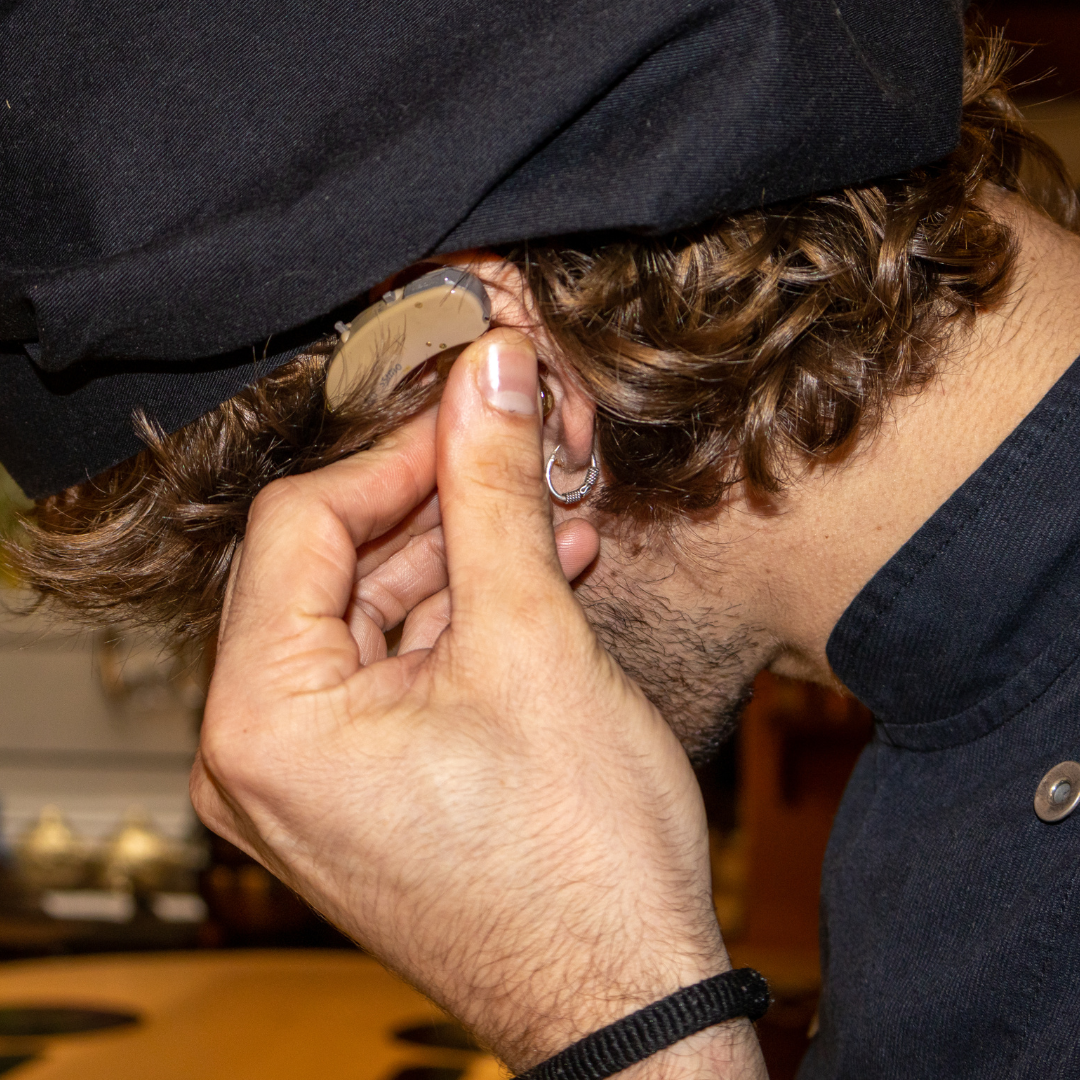
Maintaining dinner dialogue proves demanding when chaotic ambient noise strains your concentration and hearing. Our audiology clinic conducts specialized testing to evaluate hearing in both quiet sound booths and noisy simulations to isolate the underlying cause. As soon as we identify the physiological cause of your difficult hearing, we deliver personalized rehabilitation options.
Why Do I Hear Well in Quiet but Struggle in Restaurants?
Calm domestic settings establish a positive signal-to-noise ratio, allowing target speech to stand out clearly from faint background noises. Commercial restaurant spaces present the polar opposite acoustic dynamic. Layered diner voices, kitchen activity, foreground music, and room reverberation muddy speech signals, requiring intense mental strain to follow dialogue.
These communication barriers frequently indicate high-frequency hearing loss, central auditory-processing disorders, or age-related sensorineural changes. Attention, fatigue, dim lighting, and distance from the speaker may make it worse. Some patients pass standard pure-tone evaluations with normal scores yet exhibit substantial impairment during specialized speech-in-noise testing. Inability to track speech in crowded restaurants merits audiological evaluation even when standard daily hearing sounds completely normal.
The Audiological Process for High-Frequency Hearing Loss
We begin by reviewing your history of communication difficulties, prior noise exposures, ringing or tinnitus, pharmaceuticals, and unilateral symptoms.
Through pure-tone audiometry, we determine your faintest auditory perception across low to high pitches utilizing both air and bone conduction testing. High-frequency hearing loss commonly presents on the audiogram as a characteristic precipitous drop in the higher frequency ranges. Diagnostic evaluations may also integrate acoustic tympanometry to check middle-ear pressure alongside word-recognition testing to evaluate speech processing.
Since sound-treated booths cannot replicate the chaos of a crowded dining room, speech-in-noise testing provides critical real-world insight. This diagnostic protocol measures your capacity to understand target words or sentences against progressively louder multi-talker babble. Together, these audiological findings indicate whether the issue involves sound audibility, speech intelligibility, noise-processing dysfunction, or multiple compounding factors.
Adult Auditory Processing Disorders and Speech Perception
A diagnosed auditory processing disorder affects how the brain’s auditory cortex analyzes, organizes, and interprets sound. While peripheral ears may register soft tones normally, the auditory cortex struggles to filter competing noise, resolve phonetic contrasts, or keep pace with rapid conversation. We first evaluate peripheral hearing and then determine whether an individualized auditory-processing test battery or referrals to other professionals are appropriate.
Practical Strategies for Improving Speech Understanding in Noise
Small, intentional adaptations can optimize the clarity of speech reaching your ears and leverage helpful visual speech cues. Before heading out to eat, select dining spots with quieter acoustic profiles or dine during low-volume hours. Establishments designed with high-walled booths, acoustic wall treatments, heavy fabrics, and carpeting reduce reverberation far better than modern industrial spaces with bare surfaces.
Upon entering the restaurant:
- Request table placement positioned away from dishwashing stations, bustling bars, sound speakers, and celebratory gatherings.
- Sit with a perimeter wall directly behind you to cut down on ambient noise approaching from the rear.
- Position yourself directly opposite your companions where direct lighting highlights their facial expressions.
- Keep the distance between speakers as short as comfortably possible.
- Position your better-hearing ear directly toward your main conversational partner.
- Request that companions rephrase misunderstandings using different words rather than repeating the same sentence.
- Actively confirm key information rather than smiling and guessing at ambiguous dialogue.
- Step away for a brief auditory rest when cognitive listening fatigue begins to set in.
- Encourage friends to enunciate clearly while maintaining an even, normal conversational tempo.
- Yelling distorts natural speech formants and rarely makes spoken words easier to decipher.
Assistive Listening Technologies for Noisy Environments
Appropriate hearing technology is dictated by the precise diagnosis, primary listening environments, and the degree of diagnosed hearing loss. Prescription hearing aids fitted by an audiologist leverage directional microphone arrays, advanced digital noise reduction, and dedicated restaurant programs to focus on frontal speech while dampening background sound. Users should establish realistic expectations because no hearing device can fully eradicate all unwanted ambient speech.
Incorporating a dedicated remote microphone provides an even more pronounced improvement in signal-to-noise ratio. The microphone is placed near or worn by the speaker and sends that voice directly to compatible hearing aids or another receiver. Direct audio routing minimizes the acoustic penalty of conversational distance and surrounding environmental din.
Additional effective assistive technologies include:
- Omnidirectional table microphones designed for group dining tables
- Telecoils or hearing-loop systems in equipped venues
- Real-time smartphone speech-to-text transcription and live-captioning apps
- Consumer wireless earbuds or hearables featuring customizable assistive listening modes
- Decibel-monitoring apps and crowd-sourced dining platforms that track restaurant noise
Our audiology staff helps you evaluate options, ensures wireless compatibility, and trains you on operating your chosen equipment.
How Can a Doctor Help with Hearing in Loud Places?
A hearing evaluation can move the conversation beyond “I hear fine in quiet.” We analyze the exact social venues, voice registers, and noise environments that cause difficulty to administer tests matching your lifestyle. The diagnostic battery may encompass pure-tone thresholds, acoustic middle-ear evaluations, suprathreshold word recognition, and speech-in-noise measures. Advanced auditory-processing testing can be introduced whenever medical history and baseline assessments justify specialized evaluation.
Hearing changes that present abruptly, affect only one side, or progress rapidly necessitate consultation with an ear, nose, and throat physician. Individualized diagnostic care pinpoints the precise physiological etiology rather than merely blaming restaurant noise for communication struggles.
Schedule a Diagnostic Hearing Evaluation Right Away
If dining in loud spaces leaves you feeling isolated, fatigued, or guessing at missed speech, contact us to schedule a thorough hearing evaluation. We provide proven treatments to enhance your hearing in noisy environments, offering hearing aid fine-tuning, specialized assistive accessories, and individualized auditory therapy.
Contact our audiology office today to schedule your evaluation and move toward effortless, confident conversations.
